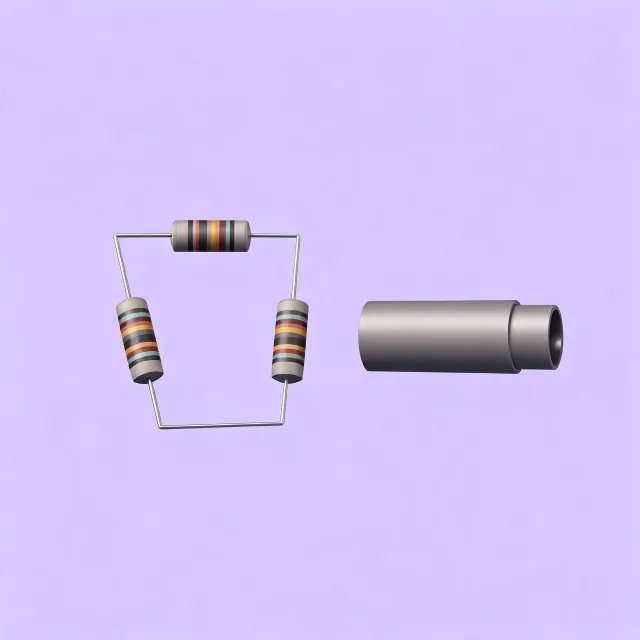
Bench sketch of a pi resistor network next to a coaxial barrel

Application lanes

pi rf attenuator resistor checks for the job in front of you

A pi rf attenuator is a three-resistor network: two shunts and one series arm. LinkScope Sourcing 33 helps a buyer turn that network into purchase lines for a radio, a lab bench, or a 75 ohm interface. The desk does not etch boards and does not claim the resistors are already in stock.

Three jobs, three different purchase lines

Radio feed at 50 ohm

For a symmetrical 50 ohm pi pad, K is 10 raised to the power of attenuation over 20. Shunt resistance is Z times (K+1) divided by (K-1). Series resistance is Z times (K squared minus 1) divided by (2K). At 3 dB, K is about 1.4125, the shunt is about 292 ohm, and the series arm is about 17.6 ohm. At 6 dB the shunt is about 150 ohm and the series arm is about 37.4 ohm. At 10 dB the shunt is about 96.2 ohm and the series arm is about 71.2 ohm. Compare those figures with the bill of materials a plant sends. A 5 percent resistor may miss a tight attenuation tolerance even when the formula is right.

Bench source protection

On a lab bench the pad protects an analyzer input. Write the generator ceiling, the analyzer damage level, and the pad average power together. Heat leaves a small PCB pi network through the copper and the resistors, not through a coaxial body. Ask for the copper area the rating assumes. A 1 W formula result on paper is not a 1 W board if the copper is a thin neck.

50 ohm radio into 75 ohm plant

A minimum-loss resistive match between 50 ohm and 75 ohm is about 5.7 dB, because 10 log10 of (square root of 1.5 plus square root of 0.5) squared is near 5.72. That pad is not the same part as a 6 dB 50 ohm pi network. If the job is CATV or a 75 ohm instrument, say so. Impedance, connector, and the extra loss all belong on the purchase line. This lane does not pick single-mode fiber attenuators. Those are optical parts. A coaxial pi pad does not set an optical budget.

Site constraints still change the buy. An outdoor radio cabinet may need a sealed inline body rather than an open PCB. A shelter rack may care about connector access with gloves. A production fixture may need a switched step instead of a fixed pi. Delivery stage matters: a prototype of 8 boards and a later release of 400 boards should not share one resistor lot assumption. Documents to request are the schematic values, the power derating note, and a return-loss statement across the band you use. Keep port licenses off this resistor sheet so they are not priced as if they were the series arm.

Background for a method, not a client result: a bench buyer once listed 10 dB and 50 ohm but omitted that the analyzer input was 75 ohm. The process was to recompute the minimum-loss pad near 5.7 dB and to split the connector. The outcome was two lines instead of one mismatched quote. No percentage was taken off a price, because no common price existed yet.

What to confirm before the pi network is released

  1. Nominal attenuation, tolerance, and the frequency points used to judge both.
  2. Impedance at each port, including any 50 to 75 ohm transition.
  3. Resistor power and the board copper or coaxial body that carries heat.
  4. Connector or footprint, and whether DC must pass.
  5. Quantity, US destination, and whether the date is ex-works or at the door.

OEM resistor kits and generic thick-film sets are a real split. A kit tied to a reference design may follow that note more closely. A generic set may be usable after the three values and the power marks are checked. New parts may show a date code. Surplus reels need a condition note. The inquiry rows name families only. The form is where the job constraints go.

Send the pi network for factory quotes

Write dB, ohms, watts, connector or footprint, quantity, destination, and timing. The desk will ask plants to answer those cells. No street address is implied by the lane sketches.

Request Factory Quotes