Quote ledger for one interface

sma rf attenuator replies compared on connector, watts, and band

Bring the SMA drawing before anyone prices an sma rf attenuator. LinkScope Sourcing 33 asks plants to answer the same gender, the same average power, and the same upper frequency. The desk is an independent sourcing partner. It does not machine coupling nuts and it does not keep a bin of barrels.

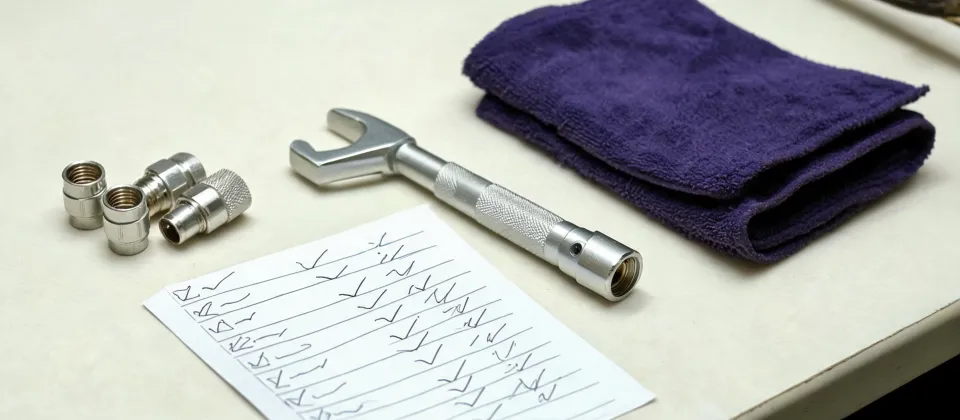
SMA attenuator barrels beside a torque wrench and a frequency checklist

Rows each supplier must fill before an SMA price is readable

Standard SMA is often discussed to 18 GHz. A precision interface may be written to 26.5 GHz. Ask which limit belongs to the offered barrel, and whether that limit is the connector alone or the attenuator with its resistors installed. Many SMA assembly notes cite about 0.9 N·m, near 8 in-lb, for the coupling nut. Copy the torque from the connector maker sheet for the exact plug. A higher torque can damage the threads. A lower torque can leave a high VSWR that the resistor network did not cause.

Power is the next split. Write average watts at a named ambient, often 25 °C, plus the derating line above that point. Then write peak power and duty cycle. A 2 W body and a 10 W body with a heatsink are different purchases even when both say 10 dB and SMA. At 10 dB, about 90 percent of a continuous input is absorbed in the pad. A 2 W average rating therefore cannot be assumed to accept a 2 W input at every temperature. Ask for the curve.

Match comes third. Request VSWR or return loss at the band edges you care about, not only at a mid-band spot. A 1.15:1 mid-band figure and a 1.35:1 figure at 18 GHz can both be true. Attenuation tolerance, such as ±0.4 dB or a percentage of the nominal value, must name the same band. DC continuity matters if the radio feeds bias through the coax. Some pads pass DC. Some block it. Say which behavior the host needs.

Exclusions change the landed total. Adapters, protective caps, a plotted S-parameter file, calibration stickers, and a matched pair of pads are separate lines. Currency, per-unit or whole-order basis, Incoterms, freight, and duties stay off the piece cell. A sample of 5 pieces and a release of 200 pieces should not be averaged into one number. See inquiry labels if the mechanical form is still open, then send quantity and the US destination on the requirement form.
Compatibility questions that an SMA name does not answer

Will it mate with the jack already on the radio?

SMA, 3.5 mm, and 2.92 mm threads can look similar and still have different pin geometry and frequency intent. Ask the supplier to name the interface standard on the drawing and to flag any adapter. A photo of a hex nut is not a mate check.

Does the host need a DC path?

A bias tee upstream of a pad fails if the pad shorts the center conductor to ground at DC. State the bias voltage and current the host applies. The plant should say whether the offered resistors block that path.

Which evidence is tied to this serial family?

Request the current datasheet, the resistor network type, and any return-loss plot for the exact model. A catalog curve for a different wattage is not a substitute. Applicable FCC questions belong to the transmitter that uses the pad, under the Part 2 Subpart J frame, and remain unconfirmed until the exact equipment is named.

New SMA barrels may carry a clearer plating lot. Refurbished barrels need a note on center-pin wear and how many mate cycles are already used. Neither condition is chosen here. An OEM-marked barrel may track a radio vendor note more closely. An unmarked barrel may be acceptable after frequency, power, and pin depth match the host. Write the choice as a preference, not as a rating.

Hand the SMA brief across for factory quotes

There is no upload control. Put gender, dB, watts, band, quantity, destination, and timing in the text. A high-end, mid-range, budget, or undecided supplier preference can sit in the optional control when script is available. It is the buyer wish, not a score this desk verified.